


-
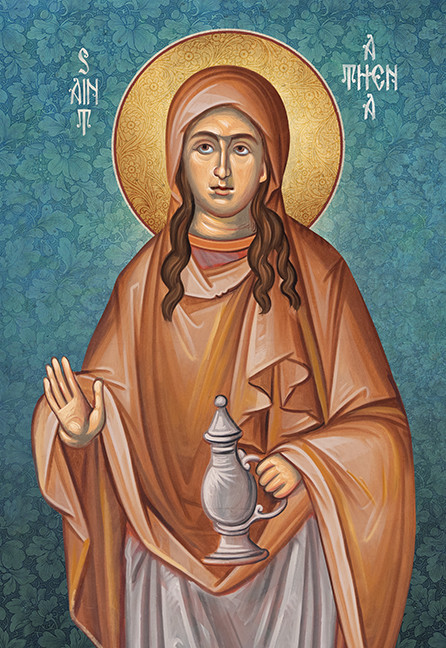
Icon of St. Athena 21st c. - 00STAT02
$38.00 - $335.00Feast Day/Commemorated: September 1 Saint Athena was one of the forty ascetic virgin-martyrs of Adrianople, Thrace, who studied under the guidance of Deacon Ammoun. During the persecutions of... -

Icon of St. Jerome -21st c. - 00STJE01
$38.00 - $335.00Feast Day/Commemorated: June 15 Saint Jerome, born Eusebius Hieronymos Sophronius in Stridon, was a pivotal figure in Christian history. He received a thorough secular education in Rome, where he... -

Icon of St. Christopher 21st c. - 00STCH02
$38.00 - $335.00Feast Day/Commemorated: May 9 Saint Christopher lived during the 3rd century and was martyred around the year 250 under the reign of Emperor Decius. He was a man of immense stature and strength,... -

Icon of St. John the Theologian - 21st c. - 00STJT01
$38.00 - $325.00Feast Day/Commemorated: May 8 The final earthly moments of Saint John the Theologian, as recounted by tradition, are shrouded in an aura of profound reverence and mystery. At over a hundred year -

Icon of St. Mark the Evangelist - 21st c. - 00STME01
$38.00 - $325.00Feast Day/Commemorated: April 25 The Holy Apostle and Evangelist Mark, also known as John Mark, was a pivotal figure in early Christianity, a nephew of Saint Barnabas and one of the Seventy Apos
Description
Feast Day/Commemorated: January 21
The Life and Early Ministry of Saint Maximus
Saint Maximus the Confessor was born into a noble family in Constantinople around 580, where he received an elite education in philosophy, rhetoric, and theology. His intellectual brilliance and virtuous character led him to a high-ranking position as the chief counselor to Emperor Heraclius. However, his tenure at court was short-lived; deeply troubled by the rise of the Monothelite heresy—which falsely claimed Christ possessed only a divine will rather than both human and divine wills—Maximus resigned his worldly honors. He sought a life of asceticism at the Chrysopolis monastery, eventually becoming its leader while maintaining a reputation for profound humility and wisdom.
Defense of Orthodoxy and Exile
As Monothelitism gained imperial backing through edicts like the Ekthesis, Maximus became the primary defender of Orthodox Christology. He traveled extensively through Africa and Rome, engaging in high-stakes public debates, most notably with the former Patriarch Pyrrhus, whom he temporarily convinced to renounce the heresy. Maximus argued that if Christ lacked a human will, His human nature would be incomplete, thereby undermining the very possibility of human salvation. His efforts culminated in the Lateran Council of 649, where Western and Eastern bishops formally condemned Monothelitism, directly defying the "Typos" edict issued by Emperor Constans II.
Martyrdom and the "Confessor"
The imperial response to Maximus’s defiance was swift and brutal. In 654, he was arrested for treason and endured years of imprisonment and interrogation. To silence his preaching and prevent him from writing, the authorities eventually cut out his tongue and severed his right hand. He was exiled to the remote region of Scythia, where he died in 662. It was through this physical suffering and refusal to recant his faith under torture that he earned the title "the Confessor," a distinction given to those who suffer for the faith without being executed immediately.
Theological Legacy and Influence
Despite the attempts to silence him, Maximus left a massive theological footprint that shaped the future of the Church. His works, such as the Mystagogia and his "Chapters on Love," synthesized the spiritual wisdom of the Desert Fathers with the rigorous logic of Greek philosophy. His most vital contribution was the doctrine of theosis (deification), teaching that through God's grace, humans can participate in the divine nature. His legacy was later championed by the Sixth Ecumenical Council and continued to influence great mystical theologians like Saint Gregory Palamas, ensuring his place as a "beacon of Orthodoxy."
This icon by the hand of Constantine Theodorou
About Our Icons (Print and Mounted):
Theophany Works Icons are handcrafted Orthodox Christian icon reproductions made in the United States with prayer and a desire for excellence. Each of our icons are printed on museum-quality matte canvas, providing a rich print with saturated coloration that lends to a beautiful handwritten-icon appearance.
All Theophany Works Icons are mounted on beveled wooden boards and finished with a high-quality UV protection sealant. This offers a subtle authentic-feeling texture while also enhancing durability, allowing for cleaning with a damp cloth. Additionally, each icon is given a maple-shelled keyhole slot on its back for easy and balanced hanging.
Our beautiful icon reproductions are lovingly made in our Lancaster, Pennsylvania studio. We pray they are a blessing to all who receive them, and we believe they will be a beloved addition to any home or parish—each at a fraction of the cost of a hand-painted icon.
***Our Beloved Brothers & Sisters in Christ: Please allow 3 weeks for production as each icon is made to order. If an icon is needed sooner for a baptism, chrismation, wedding, or name day, please contact us—we will always do our very best to accommodate your request.
